
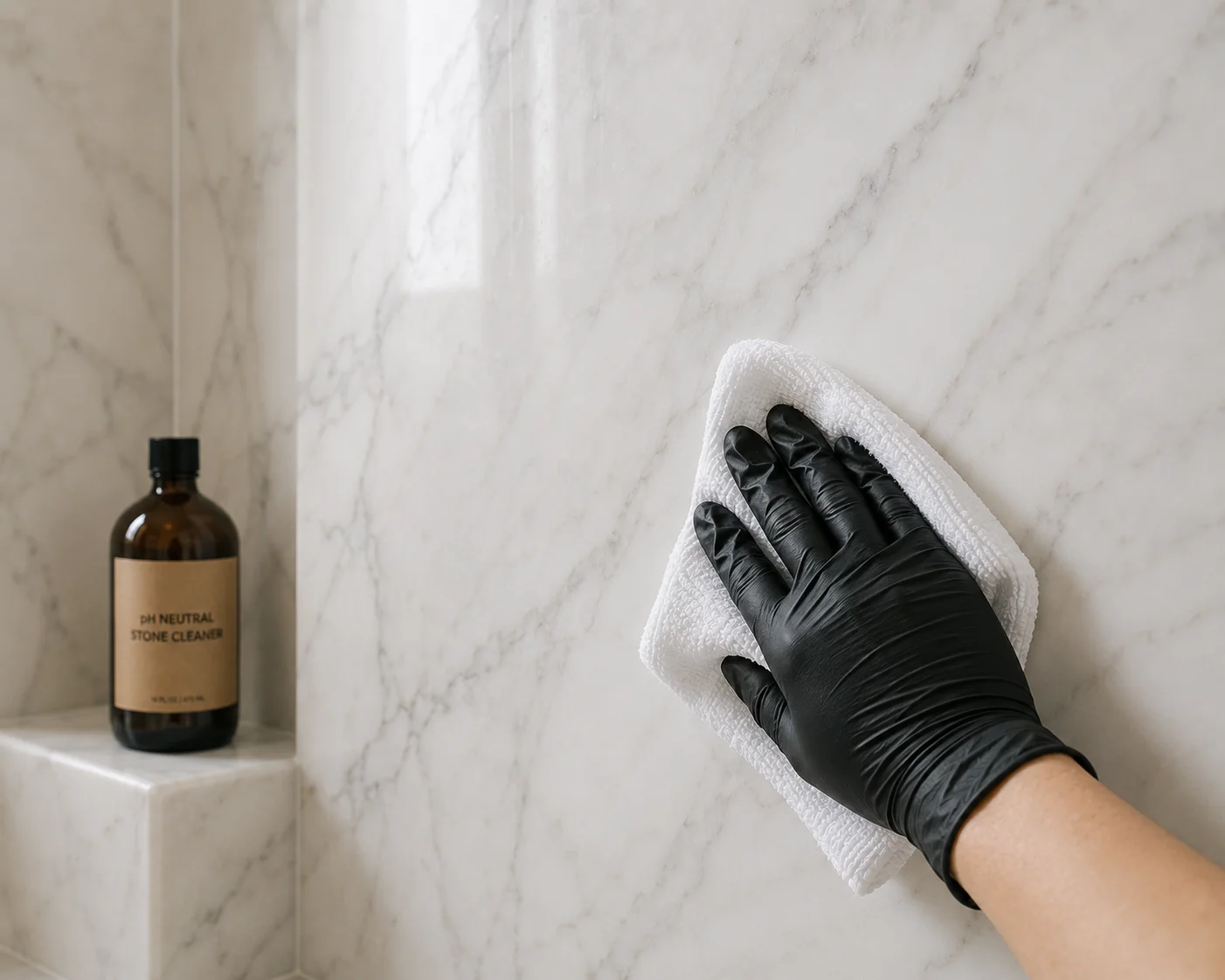
Use a pH-neutral stone cleaner or a small amount of plain dish soap diluted in warm water. Apply it with a soft microfiber cloth or a natural sponge, rinse thoroughly, and dry the surface with a clean cloth after each clean. That is the full method for routine marble shower tile cleaning.
What matters more than the method is what you avoid. Vinegar, bleach, lemon juice, abrasive scrub pads, and most standard bathroom tile cleaners all damage marble permanently. On ceramic tile these products are fine. On marble, a single application of vinegar etches the surface in a way that cannot be cleaned away.
Why Marble Needs Different Care Than Other Shower Tile
Marble is calcium carbonate, the same mineral compound found in limestone and chalk. Calcium carbonate reacts with acid on contact and dissolves at the surface, leaving a dull, rough patch called an etch mark. The reaction happens within seconds of contact with any acidic substance, including white vinegar, lemon juice, citrus-based cleaners, and most grout and tile cleaners sold for bathroom use.
Marble is also porous. Without a sealer, water, soap, shampoo, and body oils absorb directly into the stone and cause deep staining that surface cleaning cannot remove. In a shower, where the tile is wet for extended periods daily, sealing is not optional. It is the single factor that determines how well the marble holds up over time.
The combination of acid sensitivity and porosity means marble requires its own category of care products and methods. Products safe for ceramic and porcelain tile are frequently destructive on marble. Understanding why before you reach for a cleaning product is the most useful thing you can do for a marble shower.
Products That Damage Marble and Why
Vinegar is the most common mistake. White vinegar has a pH of around 2.4. Marble begins to etch at a pH below 7. The reaction is immediate and visible as a dull, slightly rough area where the polish used to be. The etch is physical erosion of the stone surface, not a stain, and it cannot be cleaned away. Restoring etched marble requires professional honing or repolishing.
Bleach does not etch marble the way acid does, but it degrades the sealer that protects the stone, strips color from marble with natural veining over time, and discolors grout in marble tile installations. Standard bathroom spray cleaners almost universally contain either acid or bleach, sometimes both. Most are not suitable for marble.
Abrasive scrubbing pads, including the green scrub side of a standard kitchen sponge, scratch polished marble. Those scratches catch soap scum and hard water deposits and become progressively harder to clean as the surface texture increases. Only soft microfiber cloths, natural sea sponges, or very soft nylon brushes on grout lines should contact marble tile.
Steam cleaners force high-temperature pressurized moisture into the stone pores and grout joints. On sealed marble the heat degrades the sealer. On unsealed or aging marble, the moisture penetrates the stone directly. Steam cleaning is not appropriate for marble tile regardless of how clean the result looks immediately after.
Daily Cleaning Routine for Marble Shower Tile
A squeegee used after every shower is the most effective single habit for marble maintenance. Squeegeeing the walls and floor removes the water that carries dissolved minerals, soap, and body oils before they dry on the surface. Hard water deposits and soap scum are far easier to prevent than to remove from marble.
After squeegeeing, leave the shower door or curtain open to allow the remaining moisture to evaporate. A marble shower in a closed, humid enclosure that stays damp between uses develops mold in grout joints and soap scum buildup faster than one that dries between showers.
For a quick daily wipe when the tile needs more than a squeegee, a soft cloth dampened with plain warm water handles surface cleaning without any product. If a cleaner is needed, a spray of pH-neutral marble or stone cleaner, applied and rinsed immediately, is the correct choice. Do not let any cleaner sit on marble without rinsing.
Deep Cleaning Marble Shower Tile
Soap Scum on Marble
Soap scum on marble is a combination of calcium stearate, formed when soap reacts with minerals in hard water, and body oil residue. It appears as a white or grey film that builds up on the tile face and grout lines over time.
Do not use acidic soap scum removers. Most commercial soap scum products contain acids specifically to dissolve the calcium in soap scum, and that same acid reacts with and etches the marble surface beneath it.
For moderate soap scum on sealed marble, apply a small amount of pH-neutral dish soap directly to a damp microfiber cloth and work it across the tile in circular motions. The surfactants in dish soap break down the oil component of soap scum without the acidity that damages marble. Rinse thoroughly with warm water and dry with a clean cloth.
For heavier soap scum that does not respond to dish soap alone, a dedicated stone-safe soap scum remover formulated specifically for natural stone is the correct product. These are available from stone care suppliers and are pH-balanced to clean without etching. Apply according to the product label, rinse fully, and dry.
Hard Water Deposits on Marble
Hard water deposits on marble are one of the most challenging cleaning problems because every effective standard descaling product is acidic, and acid damages marble. You cannot use vinegar, citric acid, or commercial limescale removers on marble tile.
For light hard water film, a pH-neutral marble cleaner applied with a soft cloth and gentle pressure is the safest starting point. For deposits that have built up over weeks or months, a marble-specific hard water remover, sometimes listed as a calcium deposit remover for natural stone, uses chelating agents rather than acid to lift mineral deposits without etching the stone. These products are available from stone care suppliers and online.
Patience matters here. Multiple applications over a few sessions with the right product produce a better result than one aggressive attempt with something that damages the marble. If hard water deposits have reached the point where they feel rough and gritty under your finger and are bonded firmly to the tile face, professional restoration may be needed to remove them without etching the surrounding stone.
Mold and Mildew on Marble Grout
Mold in marble shower grout is common because the grout is porous and stays damp. The correct approach depends on whether the mold is on the grout only or has spread to the marble tile face.
For mold on grout lines only, diluted hydrogen peroxide at three percent concentration applied to the grout with a soft toothbrush and left for five minutes before rinsing is effective and safe for marble. Do not let hydrogen peroxide pool on the marble tile face for extended periods; rinse the area thoroughly after treating the grout.
Do not use bleach on marble grout. It degrades the marble sealer at the grout-tile edge and can discolor marble with natural grey or black veining over time. It is also corrosive to grout over repeated use.
Mold that has turned the grout grey or black throughout and does not respond to hydrogen peroxide treatment has typically penetrated below the grout surface. At that point, the grout needs to be removed and replaced rather than cleaned. Sealing the fresh grout after replacement prevents rapid recolonization.
Cleaning Marble Shower Floors vs. Walls
Marble shower floors require more frequent attention than walls because they accumulate soap residue, body oil, and hard water deposits from standing water with every shower. Mosaic marble floor tiles with narrow grout lines are particularly prone to grout darkening and mold because the ratio of grout to tile surface is much higher than on larger wall tiles.
On the floor, use a soft-bristled brush rather than a mop that drags debris across the tile face. Work the cleaner along the grout lines with the brush, then rinse with a handheld showerhead directed toward the drain. Dry the floor with a towel or absorbent cloth after cleaning to prevent water from sitting on the grout.
Marble shower walls are in contact with water primarily during the shower itself and dry more quickly between uses. Weekly cleaning with a pH-neutral cleaner and a soft cloth, combined with daily squeegeeing, keeps wall tiles in good condition with minimal effort. Pay particular attention to the lower half of the walls where splash accumulates, and the corner joints where caulking meets the tile.
Does Your Marble Shower Need Resealing?
Place a few drops of water on the tile surface and observe for three to five minutes. If the water beads and stays on the surface, the sealer is intact. If the water absorbs into the stone within a few minutes and darkens the marble, the sealer has worn and the tile needs resealing before it continues to absorb water, soap, and staining with every shower.
In a shower that is used daily, marble tile typically needs resealing every six to twelve months. The sealer degrades with repeated water exposure, cleaning, and temperature changes. High-traffic showers and those using harder water wear through sealers faster.
Use an impregnating sealer specifically formulated for natural stone in wet areas. Topical sealers sit on the stone surface and wear off quickly in showers. An impregnating sealer penetrates the pores of the stone and provides protection from within the surface rather than on top of it.
To reseal, clean the tile thoroughly and allow it to dry completely, at least 24 hours. Apply the sealer according to the product instructions, wipe off the excess before it dries, and allow the curing time specified on the label before exposing the tile to water. Most impregnating sealers require 24 to 48 hours of curing time.
Safe Product and Method Reference Table
| Product or Method | Safe for Marble? | What It Does | Use Instead |
|---|---|---|---|
|
pH-neutral marble cleaner |
Yes | Cleans without etching the calcium carbonate surface | First choice for all routine cleaning |
| Dish soap (plain, pH neutral) | Yes with caution | Cuts soap scum and body oils on sealed marble |
Use sparingly, rinse fully to avoid film buildup |
|
Hydrogen peroxide 3% |
Yes for stains on light marble | Lifts organic stains on white or light marble only | Test in hidden area first, avoid on dark marble |
| Steam cleaner | No | Heat and pressure force moisture into pores and joints |
Damp mop or soft cloth instead |
|
White vinegar |
No | Etches calcium carbonate permanently on contact | pH-neutral cleaner for all acid-sensitive stone |
| Bleach or chlorine cleaners | No | Strips marble sealant and discolors grout over time |
Diluted hydrogen peroxide for mold on grout joints |
|
Abrasive scrub pads |
No | Scratches polished marble surface permanently | Soft microfiber cloth or natural sea sponge |
| Lemon juice or citrus cleaners | No | Highly acidic, etches marble on first contact |
pH-neutral cleaner only |
|
Baking soda paste |
No | Mildly abrasive, dulls polished finish with repeated use | Marble-specific poultice for stain drawing |
| Grout brush on tile face | No | Scratches polished marble surface around grout lines |
Soft toothbrush on grout lines only, not tile face |
If you also have ceramic or porcelain tile in other parts of your bathroom, our guide on how to clean bathroom ceramic tiles covers the methods and products appropriate for those surfaces.
When to Call a Professional
Etch marks that have dulled the marble polish, deep staining that has penetrated below the sealed surface, grout that needs full removal and replacement, and hard water deposits that have built up to a thick crust over months all require professional stone restoration rather than household cleaning.
Professional marble restoration involves honing and repolishing to remove etches and surface scratches, followed by professional-grade sealing. It is not a regular maintenance task but is sometimes necessary after years of cleaning with the wrong products or after heavy buildup has accumulated.
The Maid Squad has served more than 5,000 customers across Los Angeles with a 4.8-star rating. Our bathroom cleaning service covers marble and natural stone surfaces using pH-neutral products matched to the material, so the finish is protected rather than worn down with each visit.
Book your cleaning today and let our team handle your marble shower with the right products.
Learn more about our professional bathroom cleaning service and what each visit covers.
Frequently Asked Questions
Can I use vinegar to clean marble shower tile?
No. White vinegar has a pH of around 2.4, which is acidic enough to etch the calcium carbonate in marble on contact. Etching produces a dull, rough patch where the polished surface used to be. The reaction happens within seconds and the damage is permanent. Restoring etched marble requires professional honing. Use a pH-neutral stone cleaner for all routine marble shower cleaning.
How do I remove etching from marble shower tile?
Light etching, which appears as a small dull patch, can sometimes be reduced with a marble polishing powder applied with a soft cloth and worked in circular motions. These products, available from stone care suppliers, use very fine abrasives to restore a partial polish to lightly etched areas. For deeper or larger etching, professional honing followed by repolishing is the correct repair. No standard cleaning product removes etching because it is physical erosion of the stone surface, not a stain.
How often should marble shower tile be deep cleaned?
A thorough clean with a pH-neutral stone cleaner once a week keeps most marble showers in good condition alongside daily squeegeeing. In homes with hard water or heavy shower use, twice-weekly cleaning prevents soap scum and mineral deposits from building to a level where removal becomes difficult. The sealer condition affects this significantly. Well-sealed marble resists buildup more effectively and requires less frequent deep cleaning than marble with a worn or absent sealer.
Is it safe to use a steam cleaner on marble shower tile?
No. Steam cleaners force high-temperature pressurized moisture into the pores of the stone and the grout joints. On sealed marble, the heat degrades the impregnating sealer. On unsealed or aging marble, steam penetrates directly into the stone and can cause spalling and cracking over time as moisture trapped inside the stone expands. Steam is effective on ceramic and porcelain tile but should not be used on any natural stone surface in a shower.
What is the difference between a stain and an etch mark on marble?
A stain is a discoloration caused by a substance absorbing into the pores of the marble, typically appearing as a darkened area in the color of whatever caused the stain. Stains can sometimes be drawn out with a marble-specific poultice product that pulls the substance back out of the stone as it dries. An etch mark is physical erosion of the marble surface caused by acid contact. It appears as a dull, lighter patch rather than a darkened area and has a slightly rough texture compared to the surrounding polished surface. Etches cannot be cleaned away because the stone itself has been dissolved at that point. The distinction matters because the treatment for each is completely different.